Loading...
중립성에 관한 선언|
본 프로젝트는 특정 역사관이나 국가를 비판 또는 옹호하는 것을 목적으로 하지 않으며, 세계 각국 교과서 및 공식 견해의 기술 차이를 객관적으로 병치·제시합니다.
비교 아카이브Territorial issues/war1689-presentOuter Manchuria, Amur River Basin, Ussuri River Basin, Central Asian Border Area
러시아-중국 영토 분쟁
각국의 관점 요약
관련 사진1
ChinaTerritorial issues/war1689-presentOuter Manchuria, Amur River Basin, Ussuri River Basin, Central Asian Border Area
Description of Sino-Russian Border and Territorial Treaties
출처:Chinese history textbooks/government opinion (general description)
출처 성격:
정부 공식·검정 교과서번역본
The history of territorial disputes between China and Russia is a history of imperialist aggression and unequal treaties, and is an important chapter that symbolizes China's ``100-year national shame.''
### Treaty of Nerchinsk (1689)
The Treaty of Nerchinsk, the first treaty in Sino-Russian relations, was concluded as a result of the Qing Dynasty militarily repelling Russian forces advancing into Siberia. By this treaty, the Amur River Basin was confirmed as the territory of the Qing Dynasty, with the Waixing'anling (Stanovoy Mountains) and the Argun River as its borders. China evaluates this treaty as a fair treaty based on equal negotiations.
### Territorial loss due to unequal treaties (1858-1860)
In the mid-19th century, as the Qing Dynasty suffered from internal and external crises such as the Arrow War (Second Opium War) and the Taiping Rebellion, Russia took advantage of the Qing Dynasty's weakness to pursue its territorial ambitions.
By the Treaty of Aygun in 1858, Russia lost approximately 600,000 square kilometers of territory north of the Amur River (Heilongjiang). Furthermore, under the Treaty of Beijing in 1860, the coastal region east of the Ussuri River (approximately 400,000 square kilometers) was also declared Russian territory, and Russia built the ice-free port of Vladivostok (Chinese name: Haishankun) here.
These treaties were concluded through the threat of force and coercive diplomacy that took advantage of the Qing Dynasty's crisis, and are considered typical ``unequal treaties'' in Chinese history education. This territorial loss meant the loss of "Outer Manchuria," which totaled approximately 1 million square kilometers, and was an event at the core of modern China's history of humiliation.
### Sino-Soviet border conflict (1969)
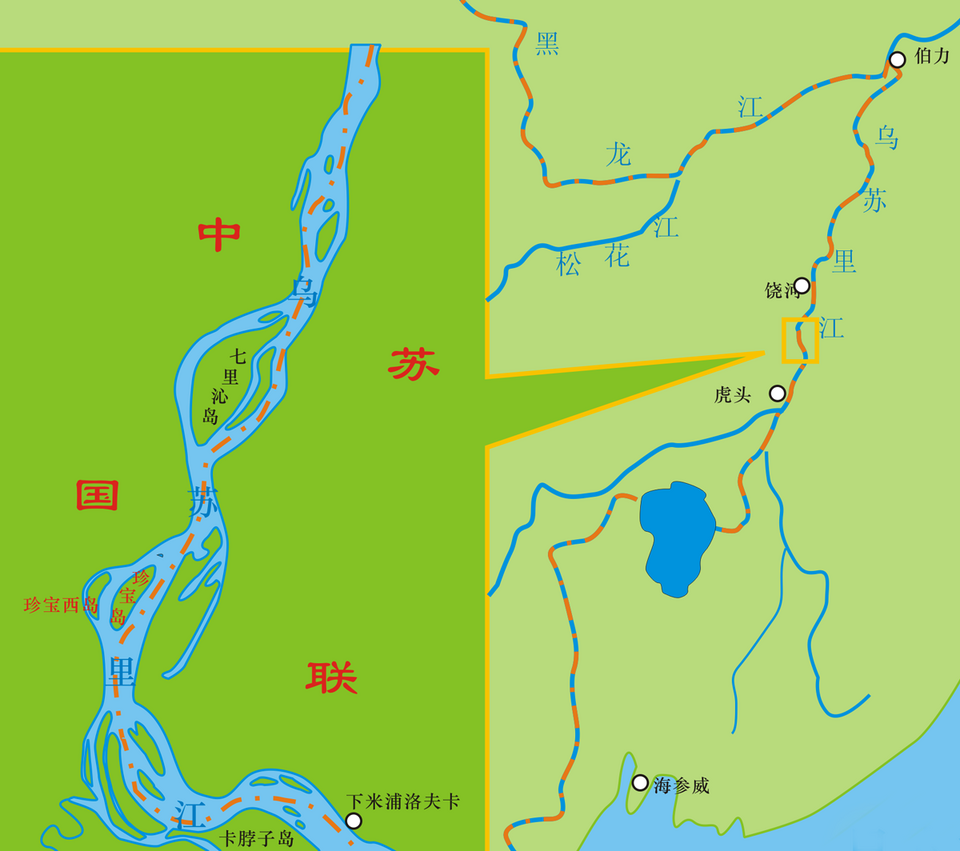
As the Sino-Soviet conflict deepened in the 1960s, tensions over ambiguous border lines escalated into military conflict. In March 1969, an armed conflict occurred between the Chinese People's Liberation Army and the Soviet Union on Zhenbao Island (Russian name: Damansky Island) in the Ussuri River. China's position is that Zhenbao Island is Chinese territory and that this was a legitimate defensive action against Soviet invasion. The conflict threatened nuclear war, but ultimately triggered diplomatic negotiations.
### Border delimitation and current situation
After the end of the Cold War, China and Russia demarcated almost the entire 4,300-kilometer border through the Eastern Border Agreement in 1991 and the Western Border Agreement in 1994. In 2004, a final agreement was reached between the two countries to divide the last outstanding issue, Kurochoshi Island (Russian name: Bolshoi Ussuri Island).
Although the Chinese government officially recognizes its current borders, history education explicitly teaches that these territorial losses were the result of "unequal treaties," and they continue to occupy an important place in the story of modern China's national humiliation and rebirth.
다각적 검증 및 대화형 체험
이 비교에 관한 보충 설명
이 비교는 각국의 공식 또는 널리 사용되는 역사 교과서의 일반적인 기술에 기반합니다. 번역 과정에서 미세한 뉘앙스가 변할 수 있지만, 주요 사건의 인식 방식, 기술 순서, 강조점의 차이를 드러내는 것을 목적으로 합니다. 특히 "China"와 "Japan" 사이에서는 사건의 명칭과 발생 배경에 대한 해석에 현저한 차이가 나타납니다.