ArchiveTerritorial issues/war1689-presentOuter Manchuria, Amur River Basin, Ussuri River Basin, Central Asian Border Area
War and territorial issues between China and Russia: China's perspective
Compare description differences in history textbooks. Select the countries you want to compare from the dropdowns.
Related Photos1
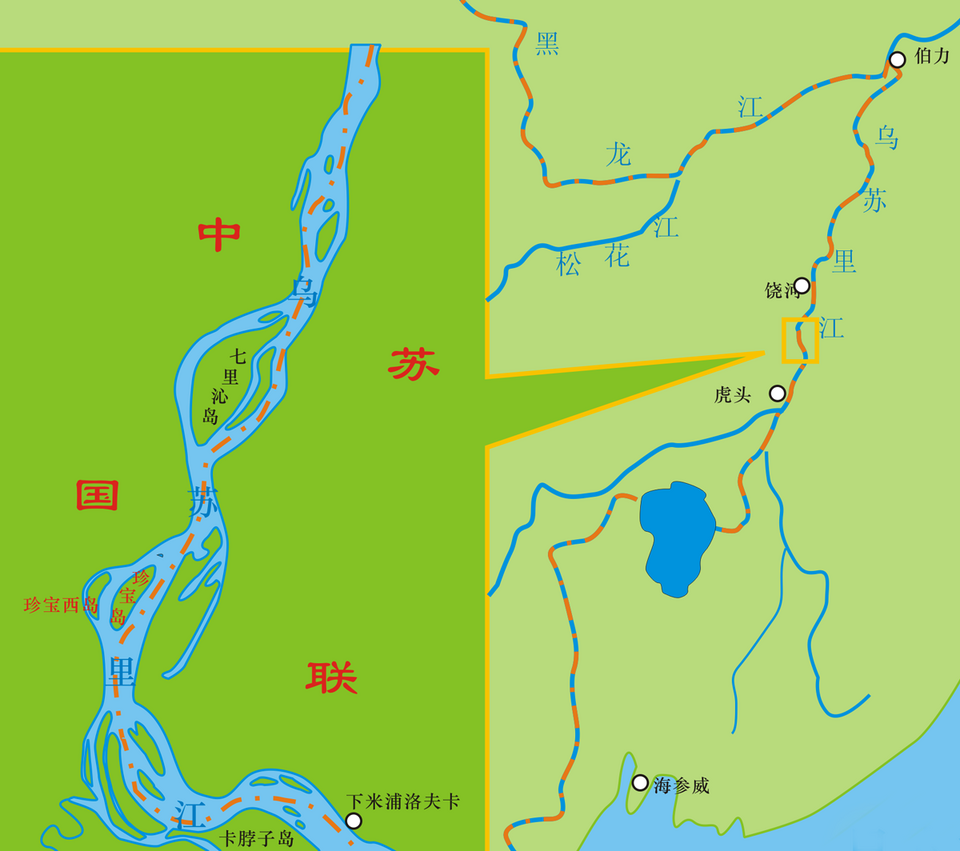
Soviet-Chinese border marker near Zhenbao (Damansky) Island, the site of a 1969 military clash. Modern texts describe the subsequent border demarcation differently.
Evidence, source links, and contextual annotations regarding descriptions.
6 notes
The Treaty of Nerchinsk was concluded in 1689 between the Qing Dynasty (Emperor Kangxi) and the Russian Empire (during the regency of Peter I). Negotiations were conducted through the mediation of the Jesuits, using Latin as the medium. This treaty made the Waixing'anling (Stanovoy Mountains) the border, and stipulated Russia's withdrawal from the Amur River basin. It is said that the military superiority of the Qing Dynasty influenced the outcome of the negotiations.
The Treaty of Aygun was concluded by Muravyov-Amursky, the Russian governor of East Siberia, under military pressure at a time when the Qing Dynasty was weakening due to the Arrow War (Second Opium War). China classifies this treaty as an ``unequal treaty,'' a product of coercive diplomacy that took advantage of the Qing Dynasty's crisis. On the other hand, Russia takes the position that this treaty is the result of legitimate diplomatic negotiations. From the perspective of international law, there is debate among scholars about the validity of treaties.
Approximately 600,000 square kilometers (north of the Amur River) was designated as Russian territory by the Treaty of Aygun (1858), and approximately 400,000 square kilometers (the coastal region east of the Ussuri River) was designated as Russian territory by the Treaty of Peking (1860). These regions are called ``Outer Manchuria'' and correspond to the present-day Russian Far East region. The fact that Vladivostok's Chinese name ``Haishenwei'' is still widely used in China shows the persistence of this historical memory.
General public opinion trends observed on social media regarding this topic.
2 voices
The following summarizes general opinion trends on social media. These are personal views, not verified facts.
Sentiment Overview
China2 voices
Nationalist
Critical
Neutral
Academic
Reconciliatory
General posts on Chinese social media aligned with the official narrative that views the strengthening of China-Russia relations favorably.
中俄关系和平边境
2020-2024
Patriotic laments over 'lost territories' that emerge among Chinese nationalist netizens when historically reviewing border treaties with Russia.
海参崴历史疆域
2020-2024
Notes on this comparison
This comparison is based on general descriptions from official or widely used history textbooks in each country. While minor nuances may change in translation, the goal is to highlight differences in how major events are perceived, the order of description, and what is emphasized. In particular, notable differences in the naming of events and the background of their occurrence can be seen between "China" and "Japan".